Deciding to run your first half marathon is an incredible milestone. You have committed to the training, you are ready to challenge yourself, and you are officially embarking on a journey that gets more fun over time. But once you make the decision to run 13.1 miles, you are immediately faced with another big question: how to choose a half marathon that is right for you?
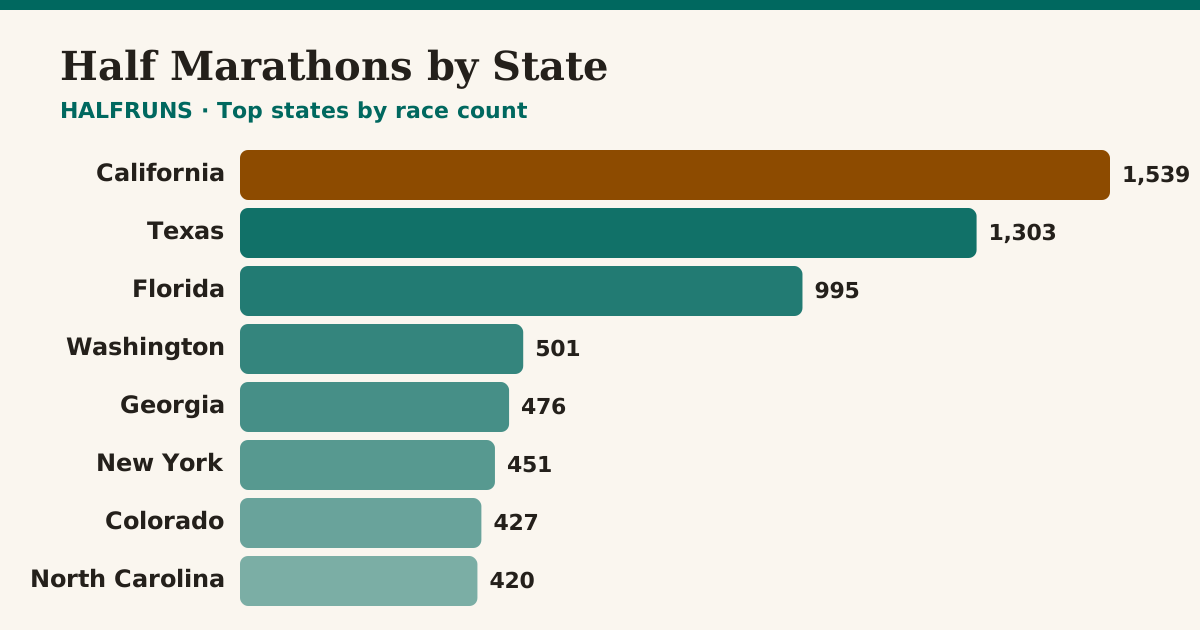
If you are looking at a race calendar and feeling completely overwhelmed, take a deep breath. You are not alone. Right now, there are 16,459 active half marathons to choose from. That is a staggering number of starting lines, finish line bananas, and race shirts.
From your first 13.1 to your fiftieth state, HalfRuns is where runners find support and race intel. We believe that finding the right race should feel exciting, not stressful. Choosing a race that fits your goals, preferences, and sense of adventure makes the entire training process more enjoyable.
Here is our practical guide on how to evaluate course terrain, field size, weather, and certification so you can choose your next adventure with confidence.
1. Consider the Training Timeline and Weather
When you pick a race date, you are not just choosing what weather you will run in on race day—you are choosing the weather you will train in for the months leading up to it.
A typical half marathon training block lasts between 12 and 16 weeks. If you choose a beautiful, crisp autumn half marathon in October, you will be doing your longest, hardest training runs during the heat and humidity of July and August. Conversely, if you sign up for an early spring race in April, you will be logging your winter miles in January and February, which might mean dealing with snow, ice, or treadmill running depending on where you live.
For your first half marathon, think about what kind of training environment will keep you motivated. If you hate the heat, a spring race might be your best bet. If you struggle to get out the door in the freezing cold, aim for a fall race. Training is easier with support, but it is also easier when the weather aligns with your preferences.
2. Evaluate Course Terrain and Elevation
Not all 13.1 miles are created equal. The terrain and elevation of a course will drastically impact how the race feels and how you should prepare for it.
Road vs. Trail
Most first-timers opt for road races. Paved roads offer a predictable, stable surface that allows you to settle into a rhythm and focus entirely on covering the distance. Trail half marathons are beautiful and adventurous, but they require navigating roots, rocks, and uneven ground. Trail miles often take significantly longer to complete than road miles. If you choose a trail race for your first half, focus purely on the experience and leave any time goals at the door.
Flat vs. Hilly
When browsing races, always look at the course elevation profile. A flat course is generally the most welcoming option for a first-timer. It allows you to find a steady pace and minimizes the muscular fatigue that comes from climbing and descending. However, some runners find perfectly flat courses a bit repetitive and prefer rolling hills to engage different muscle groups. Just be wary of courses with massive, steep climbs unless you live in an area where you can train on similar hills regularly.
3. Field Size: Big City Energy vs. Small Town Charm
The number of runners toeing the start line with you will completely change the vibe of the morning. Both large and small races have distinct advantages, and the right choice depends on what kind of environment makes you feel most comfortable.
Large Races
Massive city races offer an unforgettable atmosphere. You will experience roaring crowds, live music on the course, and the incredible energy of thousands of other runners moving toward the same goal. The support from spectators can carry you through the toughest miles.
However, large races also come with complex logistics. You often have to arrive hours before the start time, navigate crowded corrals, wait in massive lines for the porta-potties, and spend the first few miles weaving around other runners.
Small Races
Smaller, local half marathons are incredibly low-stress. You can often park your car just a few hundred feet from the start line, use a real bathroom, and warm up in peace. The logistics are a breeze, which is a huge comfort when you already have first-race jitters.
The trade-off is that crowd support will be sparse. You might find yourself running long stretches of the course entirely alone, relying on your own mental toughness to keep pushing forward.
4. What is a USATF-Certified Course?
As you browse race options, you might see the phrase "USATF-Certified" pop up. Out of the 16,459 active half marathons out there, only 751 are USATF-certified.
What does this actually mean? A certified course has been rigorously and officially measured to ensure it is exactly 13.10938 miles long. If a race is not certified, it might be slightly long or slightly short.
Does this matter for your first half marathon? Honestly, probably not! If your goal is simply to cross the finish line, have fun, and prove to yourself that you can do hard things, a non-certified local community race is a fantastic choice.
However, if you are someone who loves data, if you have a very specific time goal in mind, or if you want absolute certainty that your GPS watch and the official race results reflect a true half marathon distance, seeking out one of those 751 certified races is a smart move.
5. Hometown Race vs. Destination Race
Finally, decide whether you want to sleep in your own bed or turn your race into a travel adventure.
Running a local hometown race removes a massive layer of stress. You get to eat your normal pre-run dinner, sleep in your own bed, use your own bathroom, and drive roads you already know to get to the start line. Your friends and family can easily come out to cheer for you. For many first-timers, eliminating travel logistics makes the whole experience much more manageable.
On the other hand, a destination race turns your first half marathon into a true vacation. Traveling to a new city or a beautiful national park makes the weekend feel like a massive celebration. Just remember that traveling requires extra planning. You will need to figure out hotel accommodations, navigate a new city, and figure out where to find your preferred pre-race meals.
Ready to Find Your Race?
Choosing your first half marathon is the first step in a much bigger running story. Whether you want a flat, fast road race in your hometown or a scenic, rolling adventure across the country, the perfect starting line is out there waiting for you.
If you are ready to start exploring, you can browse half marathons by state to see what is happening in your area, or if you are feeling incredibly spontaneous, check out the races this weekend.
Start with your first 13.1. Stay for the journey after that. We are in it with you.